Politics from the Palouse to Puget Sound
Showing posts with label Endangered Species. Show all posts

Thursday, May 22, 2008

Sarah Palin for President


Sandpoint native and University of Idaho graduate Sarah Palin, the Republican Governor of Alaska, has been mentioned as a possible VP candidate.

The thought goes that the young (44), snowmobiling, socially conservative, pro-life, former beauty queen would balance out McCain's stuffy, staid, grumpy old RINO image.

It turns out Palin may be too much of a maverick for Maverick.

Palin announced yesterday that Alaska will sue to challenge the recent listing of polar bears as a threatened species. Palin fears the listing will cripple Alaska's oil and gas industry, the bread and butter of the 49th State. She stated:
The listing of a currently healthy species based entirely on highly speculative and uncertain climate and ice modeling and equally uncertain and speculative modeling of possible impacts on a species would be unprecedented.
Predictably, the environmentalist wackos started an immediate ad hominem smear campaign as they do to all global warming heretics:
She's either grossly misinformed or intentionally misleading, and both are unbecoming," said Kassie Siegel of the Center for Biological Diversity. "Alaska deserves better."

Siegel said it was unconscionable for Palin to ignore overwhelming evidence of global warming's threat to sea ice, the polar bear's habitat.

"Even the Bush administration can't deny the reality of global warming," she said. "The governor is aligning herself and the state of Alaska with the most discredited, fringe, extreme viewpoints by denying this."
On a side note, Palin participated last October in the grand opening ceremony for a Wal-Mart Supercenter in her former hometown of Wasilla, where she said:
But we are hard working, very unpretentious, just good, salt of the earth people that live here and are working in this store.
Forget about VP. An elected official gutsy enough to publicly buck the Global Warming Hysteria Express AND support Wal-Mart deserves to be President.

Friday, May 02, 2008

Quote of the Day

[University of Idaho biology graduate student Chris Looney] added the rush to have the [giant Palouse earth]worm listed as an endangered species was brought on by fear of urban sprawl striking the Palouse.

If groups like the Palouse Prairie Foundation and other groups would have used less aggressive tactics, especially in light of slow growth trends, they may have been able to curry more support from farmers, he added.
- "One percent left: Grad students seek to save Palouse prairie remnants," Whitman County Gazette, May 1, 2008

Looney was part of cross-discipline study of the biological and sociological value of the Palouse Prairie funded by a grant from the National Science Foundation. The results of the study were presented to the Whitman County commissioners last Monday.

At least the truth about the giant Palouse earthworm has come out, and as usual, it has nothing to with science.

Sunday, January 27, 2008

Mixed Econuts: No Growth Worms

I love this quote: "The giant Palouse earthworm and the Palouse habitats that it depends on are on the edge of extinction and will be lost forever if we don't act soon."

Is it any wonder people can't take the filthy, treehugging econuts seriously? Where is the science? We don't know where the giant Palouse earthworm's habitat is. We don't know how many there even are. They could all already be dead or there could be millions. BUT WE MUST ACT NOW AND HALT ALL DIGGING OR THEY WILL BE GONE FOREVER!!!! Everyone can see that this is a embarrasingly transparent attempt by the dopey local hippies to halt growth on the Palouse.

From last Friday's Moscow-Pullman Daily News:

Environmental group files suit to save earthworm

Group suing U.S. Fish and Wildlife Service over decision not to list the giant Palouse earthworm as endangered

The battle over the giant Palouse earthworm is heading to the courts after an environmental group filed a lawsuit against the U.S. Fish and Wildlife Service over its October decision to deny protection for the worm under the Endangered Species Act.

The environmental group - which includes the Palouse Prairie Foundation, the Palouse Audubon Society, Friends of the Clearwater, the Center for Biological Diversity and three private citizens - sought protection for the earthworm in August, claiming that the threat of destruction and modification of habitat, disease and predation, the inadequacy of regulatory mechanisms, and other natural and man-made factors make the earthworm a prime candidate for the Endangered Species List.

In its denial, the Fish and Wildlife Service indicated the group's petition did not contain enough information regarding the range, distribution and population size, and that data on the earthworm was too limited to add it to the endangered list. There also was not enough data to conclude the potential threats discussed in the petition posed a risk to the existence of the species now or in the future.

In a news release issued Thursday, Friends of the Clearwater board member Steve Paulson stated there may not be much time to waste if the earthworm is to be saved.

"The giant Palouse earthworm and the Palouse habitats that it depends on are on the edge of extinction and will be lost forever if we don't act soon," Paulson stated. "The earthworm needs the protection of the Endangered Species Act to survive."

The giant Palouse earthworm is the largest and longest-lived earthworm on the continent and can reach a length of three feet. It has a pinkish-white color and is reported to have a flowery smell. It lives in permanent burrows as deep as 15 feet and has been reported to spit at attackers.

The earthworm's only known habitat is the grassland of the Palouse in west-central Idaho and southeastern Washington, much of which has been destroyed by agricultural development, invasive species and pesticides.

The earthworm was described as very abundant in 1897, but has not been sighted since May 2005. Before that, it had not been sighted since 1988.

Monday, January 07, 2008

"In 2008, a 100 Percent Chance of Alarm"


A group of left-wing environmentalist wackos are attempting to get the ribbon seal put on the list of endangered species. The ribbon seal's primary habitat is drift ice in the Bering Sea, which according to the tree huggers, is being destroyed by "global warming." If the ribbon seal is listed as an endangered species, it could lead to economically crippling regulations on emissions in the U.S.. That, of course, is the point, not the protection of seals.

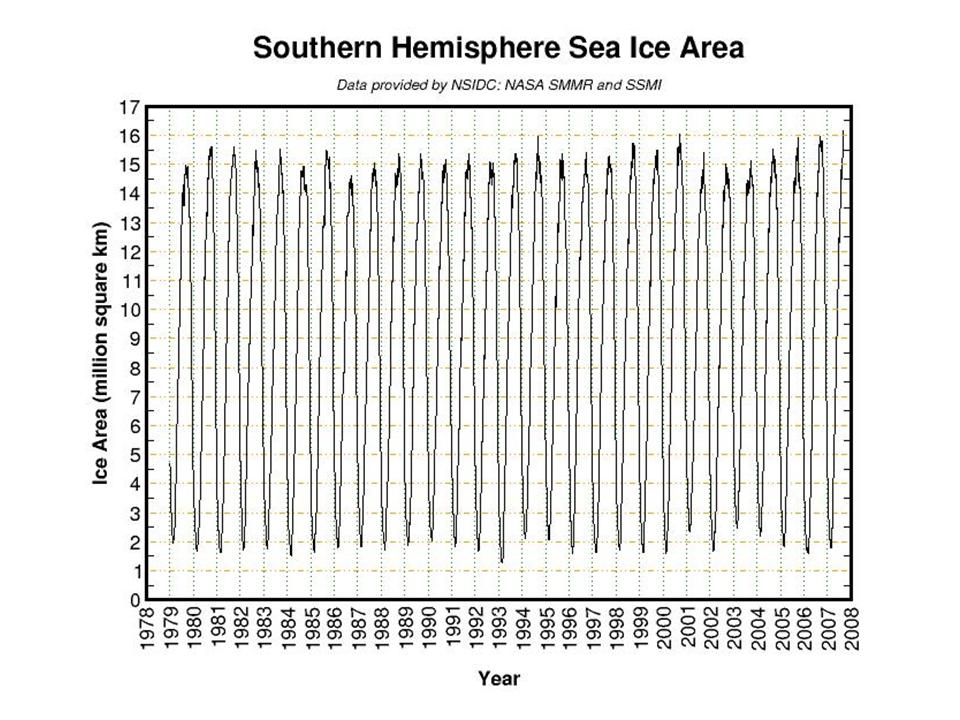
We've all seen and read the much ballyhooed coverage of the shrinking Arctic ice pack. But did you know that since 1979 (when satellite photos became available), the Antarctic ice cap has been steadily growing and the mean temperature steadily declining, with last year seeing the most Antarctic sea ice yet? I didn't think so. Western-style capitalism, in all its evil forms, must be eradicated. Global warming BS is succeeding where thousands of Soviet nuclear warheads failed. Al Gore's Travelin' Global Warming Show is rolling along, and nothing as inconsequential as the facts can be allowed to get in the way.

Or can they? James Tierney, the Science Editor of the New York Times, wrote in a column published on New Year's Day that he's had it with global warming hucksterism:
I’d like to wish you a happy New Year, but I’m afraid I have a different sort of prediction.

You’re in for very bad weather. In 2008, your television will bring you image after frightening image of natural havoc linked to global warming. You will be told that such bizarre weather must be a sign of dangerous climate change — and that these images are a mere preview of what’s in store unless we act quickly to cool the planet.

Unfortunately, I can’t be more specific. I don’t know if disaster will come by flood or drought, hurricane or blizzard, fire or ice. Nor do I have any idea how much the planet will warm this year or what that means for your local forecast. Long-term climate models cannot explain short-term weather.

But there’s bound to be some weird weather somewhere, and we will react like the sailors in the Book of Jonah. When a storm hit their ship, they didn’t ascribe it to a seasonal weather pattern. They quickly identified the cause (Jonah’s sinfulness) and agreed to an appropriate policy response (throw Jonah overboard).

Today’s interpreters of the weather are what social scientists call availability entrepreneurs: the activists, journalists and publicity-savvy scientists who selectively monitor the globe looking for newsworthy evidence of a new form of sinfulness, burning fossil fuels.

A year ago, British meteorologists made headlines predicting that the buildup of greenhouse gases would help make 2007 the hottest year on record. At year’s end, even though the British scientists reported the global temperature average was not a new record — it was actually lower than any year since 2001 — the BBC confidently proclaimed, “2007 Data Confirms Warming Trend.”

When the Arctic sea ice last year hit the lowest level ever recorded by satellites, it was big news and heralded as a sign that the whole planet was warming. When the Antarctic sea ice last year reached the highest level ever recorded by satellites, it was pretty much ignored. A large part of Antarctica has been cooling recently, but most coverage of that continent has focused on one small part that has warmed.

When Hurricane Katrina flooded New Orleans in 2005, it was supposed to be a harbinger of the stormier world predicted by some climate modelers. When the next two hurricane seasons were fairly calm — by some measures, last season in the Northern Hemisphere was the calmest in three decades — the availability entrepreneurs changed the subject. Droughts in California and Australia became the new harbingers of climate change (never mind that a warmer planet is projected to have more, not less, precipitation over all).

The most charitable excuse for this bias in weather divination is that the entrepreneurs are trying to offset another bias. The planet has indeed gotten warmer, and it is projected to keep warming because of greenhouse emissions, but this process is too slow to make much impact on the public.

When judging risks, we often go wrong by using what’s called the availability heuristic: we gauge a danger according to how many examples of it are readily available in our minds. Thus we overestimate the odds of dying in a terrorist attack or a plane crash because we’ve seen such dramatic deaths so often on television; we underestimate the risks of dying from a stroke because we don’t have so many vivid images readily available.

Slow warming doesn’t make for memorable images on television or in people’s minds, so activists, journalists and scientists have looked to hurricanes, wild fires and starving polar bears instead. They have used these images to start an “availability cascade,” a term coined by Timur Kuran, professor of economics and political science at Duke University, and Cass R. Sunstein, a law professor at the University of Chicago.

The availability cascade is a self-perpetuating process: the more attention a danger gets, the more worried people become, leading to more news coverage and more fear. Once the images of Sept. 11 made terrorism seem a major threat, the press and the police lavished attention on potential new attacks and supposed plots. After Three Mile Island and “The China Syndrome,” minor malfunctions at nuclear power plants suddenly became newsworthy.

“Many people concerned about climate change,” Dr. Sunstein says, “want to create an availability cascade by fixing an incident in people’s minds. Hurricane Katrina is just an early example; there will be others. I don’t doubt that climate change is real and that it presents a serious threat, but there’s a danger that any ‘consensus’ on particular events or specific findings is, in part, a cascade.”

Once a cascade is under way, it becomes tough to sort out risks because experts become reluctant to dispute the popular wisdom, and are ignored if they do. Now that the melting Arctic has become the symbol of global warming, there’s not much interest in hearing other explanations of why the ice is melting — or why the globe’s other pole isn’t melting, too.

Global warming has an impact on both polar regions, but they’re also strongly influenced by regional weather patterns and ocean currents. Two studies by NASA and university scientists last year concluded that much of the recent melting of Arctic sea ice was related to a cyclical change in ocean currents and winds, but those studies got relatively little attention — and were certainly no match for the images of struggling polar bears so popular with availability entrepreneurs.

Roger A. Pielke Jr., a professor of environmental studies at the University of Colorado, recently noted the very different reception received last year by two conflicting papers on the link between hurricanes and global warming. He counted 79 news articles about a paper in the Philosophical Transactions of the Royal Society, and only 3 news articles about one in a far more prestigious journal, Nature.

Guess which paper jibed with the theory — and image of Katrina — presented by Al Gore’s “Inconvenient Truth”?

It was, of course, the paper in the more obscure journal, which suggested that global warming is creating more hurricanes. The paper in Nature concluded that global warming has a minimal effect on hurricanes. It was published in December — by coincidence, the same week that Mr. Gore received his Nobel Peace Prize.

In his acceptance speech, Mr. Gore didn’t dwell on the complexities of the hurricane debate. Nor, in his roundup of the 2007 weather, did he mention how calm the hurricane season had been. Instead, he alluded somewhat mysteriously to “stronger storms in the Atlantic and Pacific,” and focused on other kinds of disasters, like “massive droughts” and “massive flooding.”

“In the last few months,” Mr. Gore said, “it has been harder and harder to misinterpret the signs that our world is spinning out of kilter.” But he was being too modest. Thanks to availability entrepreneurs like him, misinterpreting the weather is getting easier and easier.

Tuesday, October 09, 2007

Let's Go Fishin'!

The giant Palouse earthworm will not be listed as an endangered species. Hallelujah! This decision, on the heels of the Washington Department of Ecology's approval of the Hawkins water transfer approvals, puts this week off to a great start. From the the U.S. Fish and Wildlife Service:
DEPARTMENT OF THE INTERIOR

Fish and Wildlife Service

50 CFR Part 17

Endangered and Threatened Wildlife and Plants; 90-Day Finding on a Petition To List the Giant Palouse Earthworm as Threatened or Endangered
AGENCY: Fish and Wildlife Service, Interior.

ACTION: Notice of 90-day petition finding.

--------------------------------------------------------------------------------

SUMMARY: We, the U.S. Fish and Wildlife Service (Service), announce a 90-day finding on a petition to list the giant Palouse earthworm (Driloleirus americanus) as threatened or endangered under the Endangered Species Act of 1973, as amended. We find that the petition does not provide substantial scientific or commercial information to indicate that listing the giant Palouse earthworm may be warranted. Therefore, we will not be initiating a status review in response to this petition. However, we encourage the public to submit to us any new information that becomes available concerning this species.

Tuesday, September 11, 2007

"Area groups dig in for a fight"

I predicted this was coming a year ago. To quote from a letter in the Lewiston Tribune last year:
You farmers might just as well sell your property now, because you will be doing it later if they do indeed give the worm endangered status. You will no longer be allowed to continue your way of life on the land that you own.
Too bad Whitman County residents were scared into voting against I-933. If the giant Palouse earthworm gets endangered species status, "urban sprawl" will be the least of Aaron Flansburg's concerns. Hysteria over the worm and water will be used by the leftists to make sure another shovel of dirt for development is never turned on the Palouse again.

From today's Moscow-Pullman Daily News:
Friends of the Clearwater, Palouse Prairie Foundation among conservation groups threatening to sue for endangered species listing

Several Palouse-area conservation groups have filed a 60-day formal notice of intent to sue the U.S. Fish and Wildlife Service in an attempt to have the giant Palouse earthworm listed as an endangered species.

The conservation groups, which include the Center for Biological Diversity, Friends of the Clearwater and the Palouse Prairie Foundation, filed the notice after the U.S. Fish and Wildlife Service failed to respond to a petition filed in August requesting the earthworm - Driloleirus americanus - be listed as an endangered species.

Steve Paulson, a board member of Friends of the Clearwater, said by not responding, the department violated a federal law that mandates a 90-day finding and a 12-month finding.

The 90-day finding determines whether the petitioner provided sufficient information to move forward with the petition, while the 12-month finding proposes to either list the species, not list it, or place it on the precluded candidate list, which acts as a waiting list.

Tom Buckley, external affairs representative for the Upper Columbia Fish and Wildlife Office in Spokane Valley, Wash., said the petition had been received and is in the department's system.

"The work has been done and it is being reviewed," Buckley said.

Buckley said he did not know when the review would be complete.

Paulson said he does not blame the regional office in Spokane for the lack of action, but rather the policies of President George Bush.

"The regional office has been very interested but they have their hands tied by the federal government," Paulson said. "The Bush administration has put a de facto hold on adding endangered species to the list. They have the worst record for additions to lists."

Paulson said the current administration has only added 58 species to the list, while the Clinton administration added 522 species.

"This worm represents an opportunity to possibly help protect the native Palouse prairie," Paulson said.

Paulson said if the earthworm made it onto the endangered species list, the Idaho Department of Transportation would have to take the worms' welfare into consideration when planning and completing the remaining portion of U.S. Highway 95 from Thorn Creek Road to Moscow.

Paulson said a section of the highway located on Paradise Ridge travels directly through what may be prime real estate for the earthworm.

"They would have to consider whether they are endangering this worm," Paulson said.

IDT Senior Environmental Planner Zach Funkhouser said listing the earthworm likely would not result in the halting of construction.

Funkhouser said IDT would have to prepare a biological assessment that would describe the area and provide a statement of anticipated effects. The Fish and Wildlife Service would then evaluate the assessment and approve, deny or offer comments.

"Generally the outcome is you get some sort of approval to move forward," Funkhouser said. "More than likely they would just require additional steps."

IDT Project Manager Ken Helm said he does not expect any issues with construction to arise.

"I know that we really don't have too much concern about it," Helm said.

The giant Palouse earthworm is the largest and longest-lived earthworm on the continent and can reach a length of 3 feet. It has a pinkish-white color and is reported to have a flowery smell. It lives in permanent burrows as deep as 15 feet and has been reported to spit at attackers to escape predators.

The earthworm's only known habitat is the grassland of the Palouse in west-central Idaho and southeastern Washington, much of which has been destroyed by agricultural and development, invasive species and pesticides.

The earthworm was described as very abundant in 1897, but has not been sighted since May 2005. Before that, it had not been sighted since 1988.