I have heard of the Sports Illustrated jinx. Is there a Nobel jinx?


THE STARK headline appeared just over a year ago. "2007 to be 'warmest on record,' " BBC News reported on Jan. 4, 2007. Citing experts in the British government's Meteorological Office, the story announced that "the world is likely to experience the warmest year on record in 2007," surpassing the all-time high reached in 1998.
But a funny thing happened on the way to the planetary hot flash: Much of the planet grew bitterly cold.
In South America, for example, the start of winter last year was one of the coldest ever observed. According to Eugenio Hackbart, chief meteorologist of the MetSul Weather Center in Brazil, "a brutal cold wave brought record low temperatures, widespread frost, snow, and major energy disruption." In Buenos Aires, it snowed for the first time in 89 years, while in Peru the cold was so intense that hundreds of people died and the government declared a state of emergency in 14 of the country's 24 provinces. In August, Chile's agriculture minister lamented "the toughest winter we have seen in the past 50 years," which caused losses of at least $200 million in destroyed crops and livestock.
Latin Americans weren't the only ones shivering.
University of Oklahoma geophysicist David Deming, a specialist in temperature and heat flow, notes in the Washington Times that "unexpected bitter cold swept the entire Southern Hemisphere in 2007." Johannesburg experienced its first significant snowfall in a quarter-century. Australia had its coldest ever June. New Zealand's vineyards lost much of their 2007 harvest when spring temperatures dropped to record lows.
Closer to home, 44.5 inches of snow fell in New Hampshire last month, breaking the previous record of 43 inches, set in 1876. And the Canadian government is forecasting the coldest winter in 15 years.
Now all of these may be short-lived weather anomalies, mere blips in the path of the global climatic warming that Al Gore and a host of alarmists proclaim the deadliest threat we face. But what if the frigid conditions that have caused so much distress in recent months signal an impending era of global cooling?
"Stock up on fur coats and felt boots!" advises Oleg Sorokhtin, a fellow of the Russian Academy of Natural Sciences and senior scientist at Moscow's Shirshov Institute of Oceanography. "The latest data . . . say that earth has passed the peak of its warmer period, and a fairly cold spell will set in quite soon, by 2012."
Sorokhtin dismisses the conventional global warming theory that greenhouse gases, especially human-emitted carbon dioxide, is causing the earth to grow hotter. Like a number of other scientists, he points to solar activity - sunspots and solar flares, which wax and wane over time - as having the greatest effect on climate.
"Carbon dioxide is not to blame for global climate change," Sorokhtin writes in an essay for Novosti. "Solar activity is many times more powerful than the energy produced by the whole of humankind." In a recent paper for the Danish National Space Center, physicists Henrik Svensmark and Eigil Friis-Christensen concur: "The sun . . . appears to be the main forcing agent in global climate change," they write.
Given the number of worldwide cold events, it is no surprise that 2007 didn't turn out to be the warmest ever. In fact, 2007's global temperature was essentially the same as that in 2006 - and 2005, and 2004, and every year back to 2001. The record set in 1998 has not been surpassed. For nearly a decade now, there has been no global warming. Even though atmospheric carbon dioxide continues to accumulate - it's up about 4 percent since 1998 - the global mean temperature has remained flat. That raises some obvious questions about the theory that CO2 is the cause of climate change.
Yet so relentlessly has the alarmist scenario been hyped, and so disdainfully have dissenting views been dismissed, that millions of people assume Gore must be right when he insists: "The debate in the scientific community is over."
But it isn't. Just last month, more than 100 scientists signed a strongly worded open letter pointing out that climate change is a well-known natural phenomenon, and that adapting to it is far more sensible than attempting to prevent it. Because slashing carbon dioxide emissions means retarding economic development, they warned, "the current UN approach of CO2 reduction is likely to increase human suffering from future climate change rather than to decrease it."
Climate science isn't a religion, and those who dispute its leading theory are not heretics. Much remains to be learned about how and why climate changes, and there is neither virtue nor wisdom in an emotional rush to counter global warming - especially if what's coming is a global Big Chill.
I’d like to wish you a happy New Year, but I’m afraid I have a different sort of prediction.
You’re in for very bad weather. In 2008, your television will bring you image after frightening image of natural havoc linked to global warming. You will be told that such bizarre weather must be a sign of dangerous climate change — and that these images are a mere preview of what’s in store unless we act quickly to cool the planet.
Unfortunately, I can’t be more specific. I don’t know if disaster will come by flood or drought, hurricane or blizzard, fire or ice. Nor do I have any idea how much the planet will warm this year or what that means for your local forecast. Long-term climate models cannot explain short-term weather.
But there’s bound to be some weird weather somewhere, and we will react like the sailors in the Book of Jonah. When a storm hit their ship, they didn’t ascribe it to a seasonal weather pattern. They quickly identified the cause (Jonah’s sinfulness) and agreed to an appropriate policy response (throw Jonah overboard).
Today’s interpreters of the weather are what social scientists call availability entrepreneurs: the activists, journalists and publicity-savvy scientists who selectively monitor the globe looking for newsworthy evidence of a new form of sinfulness, burning fossil fuels.
A year ago, British meteorologists made headlines predicting that the buildup of greenhouse gases would help make 2007 the hottest year on record. At year’s end, even though the British scientists reported the global temperature average was not a new record — it was actually lower than any year since 2001 — the BBC confidently proclaimed, “2007 Data Confirms Warming Trend.”
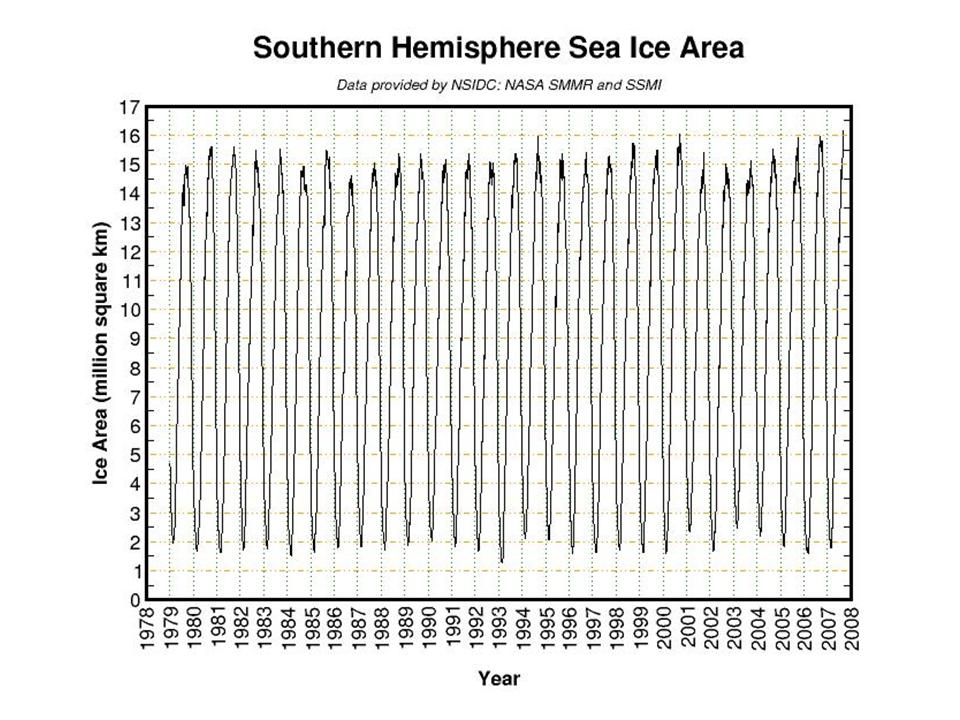
When the Arctic sea ice last year hit the lowest level ever recorded by satellites, it was big news and heralded as a sign that the whole planet was warming. When the Antarctic sea ice last year reached the highest level ever recorded by satellites, it was pretty much ignored. A large part of Antarctica has been cooling recently, but most coverage of that continent has focused on one small part that has warmed.
When Hurricane Katrina flooded New Orleans in 2005, it was supposed to be a harbinger of the stormier world predicted by some climate modelers. When the next two hurricane seasons were fairly calm — by some measures, last season in the Northern Hemisphere was the calmest in three decades — the availability entrepreneurs changed the subject. Droughts in California and Australia became the new harbingers of climate change (never mind that a warmer planet is projected to have more, not less, precipitation over all).
The most charitable excuse for this bias in weather divination is that the entrepreneurs are trying to offset another bias. The planet has indeed gotten warmer, and it is projected to keep warming because of greenhouse emissions, but this process is too slow to make much impact on the public.
When judging risks, we often go wrong by using what’s called the availability heuristic: we gauge a danger according to how many examples of it are readily available in our minds. Thus we overestimate the odds of dying in a terrorist attack or a plane crash because we’ve seen such dramatic deaths so often on television; we underestimate the risks of dying from a stroke because we don’t have so many vivid images readily available.
Slow warming doesn’t make for memorable images on television or in people’s minds, so activists, journalists and scientists have looked to hurricanes, wild fires and starving polar bears instead. They have used these images to start an “availability cascade,” a term coined by Timur Kuran, professor of economics and political science at Duke University, and Cass R. Sunstein, a law professor at the University of Chicago.
The availability cascade is a self-perpetuating process: the more attention a danger gets, the more worried people become, leading to more news coverage and more fear. Once the images of Sept. 11 made terrorism seem a major threat, the press and the police lavished attention on potential new attacks and supposed plots. After Three Mile Island and “The China Syndrome,” minor malfunctions at nuclear power plants suddenly became newsworthy.
“Many people concerned about climate change,” Dr. Sunstein says, “want to create an availability cascade by fixing an incident in people’s minds. Hurricane Katrina is just an early example; there will be others. I don’t doubt that climate change is real and that it presents a serious threat, but there’s a danger that any ‘consensus’ on particular events or specific findings is, in part, a cascade.”
Once a cascade is under way, it becomes tough to sort out risks because experts become reluctant to dispute the popular wisdom, and are ignored if they do. Now that the melting Arctic has become the symbol of global warming, there’s not much interest in hearing other explanations of why the ice is melting — or why the globe’s other pole isn’t melting, too.
Global warming has an impact on both polar regions, but they’re also strongly influenced by regional weather patterns and ocean currents. Two studies by NASA and university scientists last year concluded that much of the recent melting of Arctic sea ice was related to a cyclical change in ocean currents and winds, but those studies got relatively little attention — and were certainly no match for the images of struggling polar bears so popular with availability entrepreneurs.
Roger A. Pielke Jr., a professor of environmental studies at the University of Colorado, recently noted the very different reception received last year by two conflicting papers on the link between hurricanes and global warming. He counted 79 news articles about a paper in the Philosophical Transactions of the Royal Society, and only 3 news articles about one in a far more prestigious journal, Nature.
Guess which paper jibed with the theory — and image of Katrina — presented by Al Gore’s “Inconvenient Truth”?
It was, of course, the paper in the more obscure journal, which suggested that global warming is creating more hurricanes. The paper in Nature concluded that global warming has a minimal effect on hurricanes. It was published in December — by coincidence, the same week that Mr. Gore received his Nobel Peace Prize.
In his acceptance speech, Mr. Gore didn’t dwell on the complexities of the hurricane debate. Nor, in his roundup of the 2007 weather, did he mention how calm the hurricane season had been. Instead, he alluded somewhat mysteriously to “stronger storms in the Atlantic and Pacific,” and focused on other kinds of disasters, like “massive droughts” and “massive flooding.”
“In the last few months,” Mr. Gore said, “it has been harder and harder to misinterpret the signs that our world is spinning out of kilter.” But he was being too modest. Thanks to availability entrepreneurs like him, misinterpreting the weather is getting easier and easier.
What are the chances a suit like that would succeed in the U.S.?The film claims that melting snows on Mount Kilimanjaro evidence global warming. The Government's expert was forced to concede that this is not correct. The film suggests that evidence from ice cores proves that rising CO2 causes temperature increases over 650,000 years. The Court found that the film was misleading: over that period the rises in CO2 lagged behind the temperature rises by 800-2000 years. The film uses emotive images of Hurricane Katrina and suggests that this has been caused by global warming. The Government's expert had to accept that it was "not possible" to attribute one-off events to global warming. The film shows the drying up of Lake Chad and claims that this was caused by global warming. The Government's expert had to accept that this was not the case. The film claims that a study showed that polar bears had drowned due to disappearing arctic ice. It turned out that Mr Gore had misread the study: in fact four polar bears drowned and this was because of a particularly violent storm. The film threatens that global warming could stop the Gulf Stream throwing Europe into an ice age: the Claimant's evidence was that this was a scientific impossibility. The film blames global warming for species losses including coral reef bleaching. The Government could not find any evidence to support this claim. The film suggests that the Greenland ice covering could melt causing sea levels to rise dangerously. The evidence is that Greenland will not melt for millennia. The film suggests that the Antarctic ice covering is melting, the evidence was that it is in fact increasing. The film suggests that sea levels could rise by 7m causing the displacement of millions of people. In fact the evidence is that sea levels are expected to rise by about 40cm over the next hundred years and that there is no such threat of massive migration. The film claims that rising sea levels has caused the evacuation of certain Pacific islands to New Zealand. The Government are unable to substantiate this and the Court observed that this appears to be a false claim.

The effect of the correction on global temperatures is minor (some 1-2% less warming than originally thought), but the effect on the U.S. global warming propaganda machine could be huge.You can say that again. If there is a "conspiracy" about global warming, I think this shows where it lies.
Q: There's a lot of debate right now over the best way to communicate about global warming and get people motivated. Do you scare people or give them hope? What's the right mix?
Gore: I think the answer to that depends on where your audience's head is. In the United States of America, unfortunately we still live in a bubble of unreality. And the Category 5 denial is an enormous obstacle to any discussion of solutions. Nobody is interested in solutions if they don't think there's a problem. Given that starting point, I believe it is appropriate to have an over-representation of factual presentations on how dangerous it is, as a predicate for opening up the audience to listen to what the solutions are, and how hopeful it is that we are going to solve this crisis.


