By Alan Zarembo
Los Angeles Times
The Oscar-winning film "An Inconvenient Truth" touted itself as the world's first carbon-neutral documentary.
The producers said that every ounce of carbon emitted during production — from jet travel, electricity for filming and gasoline for cars and trucks — was counterbalanced by reducing emissions somewhere else. It only made sense that a film about the perils of global warming wouldn't contribute to the problem.
Co-producer Lesley Chilcott used an online calculator to estimate that shooting the film used 41.4 tons of carbon dioxide and paid a middleman, a company called Native Energy, $12 a ton, or $496.80, to broker a deal to cut greenhouse gases elsewhere. The film's distributors later made a similar payment to neutralize carbon dioxide from the movie's marketing.
It was a ridiculously good deal with one problem: So far, it has not led to any additional emissions reductions.
Beneath the feel-good simplicity of buying your way to carbon neutrality is a growing concern that the idea is more hype than solution.
According to Native Energy, money from "An Inconvenient Truth," along with payments from others trying to neutralize their emissions, went to the developers of a methane collector on a Pennsylvanian farm and three wind turbines in an Alaskan village.
As it turned out, both projects already had been designed and financed, and the contributions from Native Energy covered only a minor fraction of their costs.
"If you really believe you're carbon-neutral, you're kidding yourself," said Gregg Marland, a fossil-fuel pollution expert at Oak Ridge National Laboratory in Tennessee. "You can't get out of it that easily."
The race to save the planet from global warming has spawned an industry of middlemen selling environmental salvation at bargain prices.
The companies take millions of dollars collected from their customers and funnel them into carbon-cutting projects, such as tree farms in Ecuador, windmills in Minnesota and no-till fields in Iowa.
In return, customers get to claim the reductions, known as voluntary carbon offsets, as their own. For less than $100 a year, even a Hummer can be pollution-free — at least on paper.
Driven by guilt, public relations or genuine concern over global warming, tens of thousands of people have bought offsets to zero out their carbon effect on the planet.
"It made me feel better about driving my car," said Nicky Tenpas, a 29-year-old occupational therapist from Hermosa Beach, Calif., who bought offsets to neutralize emissions from the Jeep she always wanted.
Offset companies stress that they are not a cure-all for the world's greenhouse-gas emissions, which are equivalent to 54 billion tons of carbon dioxide each year.
Tom Boucher, chief executive of Native Energy, said people first should reduce their energy consumption and waste and then buy offsets. "The only way to really get to zero unless you stop driving, stop traveling."
But the industry is clouded by an approach to carbon accounting that makes it easy to claim reductions that didn't occur. Many projects that have received money from offset companies would have reduced emissions by the same amount anyway.
The growing popularity of offsets has prompted the Federal Trade Commission to begin looking into the $55-million-a-year industry.
"Everybody would like to find happy-face, win-win solutions that don't cost anything," said Robert Stavins, an environmental economist at Harvard University. "Unfortunately, they don't exist."
Lagoon an opportunity
In the rolling hills of southwestern Pennsylvania, outside the town of Berlin, Dave Van Gilder's family has been raising cows for four decades. He and his twin sons, Jason and Justin, tend to their 400 Holsteins while his wife, Connie, keeps the books.
The smell of manure has long been the sweet exhaust of a dairy farm running full tilt.
Millions of pounds of cow excrement over the decades were funneled from the barns to a 3.3-million-gallon lagoon, where it decayed, burping invisible clouds of the potent greenhouse-gas methane.
In the days of Van Gilder's father, nobody cared about the greenhouse gases.
But things began to change a few years ago. Van Gilder didn't know it, but his lagoon had become an economic opportunity.
A local congressman urged him to apply for a state alternative-energy grant to build a system that would capture methane from cow manure and burn it to generate electricity.
The project, known as a methane digester, would cost about $750,000 — $631,000 of it coming from the state and the U.S. Department of Agriculture.
Van Gilder had to make up the difference, but he figured he could earn that back — and in several years start making money — by supplying electricity for the farm and selling the excess to the local utility.
A year before construction began, Van Gilder was contacted by Native Energy, which wanted to buy his emissions reduction, along with the reductions of others who had won state energy grants.
Van Gilder had never heard of the company or the idea of selling clean air.
Nothing came of his discussions with the company until construction started on the tank for heating manure. He gladly signed a contract to sell Native Energy 29,000 tons in carbon-dioxide reductions — the company's estimate of how much greenhouse gas the digester will keep out of the atmosphere over the next 20 years.
"There wasn't a lot of negotiation," said Van Gilder, who was happy to accept whatever the company was offering.
Family members said the contract forbid them from disclosing the payment, but based on a contract with another dairy farmer, signed with Native Energy, it was about $70,000, or $2.40 a ton.
Justin Van Gilder said the money had nothing to do with the family's decision to build its methane plant. "It was a free bonus," he said.
"We still don't understand it all," Connie Van Gilder said. "It's hard for us to fathom, to see what it is doing."
Eager for offsets
The situation was similar for the Alaska Village Electric Cooperative, a utility for dozens of remote communities.
In early 2006, account manager Brent Petrie was at an Anchorage environmental conference talking about a windmill project that the cooperative was building in the Yup'ik Eskimo village of Kasigluk, a soggy patch of tundra on the remote Yukon-Kuskokwim Delta in western Alaska.
Rising 100 feet over the landscape, the three 100-kilowatt turbines were intended to reduce the area's dependence on diesel generators, whose fuel must be shipped in on barges. Federal grants were covering $2.8 million of the project's $3.1 million cost.
Petrie barely had finished his presentation when he was cornered by representatives from two brokers — Native Energy and the Bonneville Environmental Foundation — eager to buy the project's offsets.
The cooperative sold 25 years of carbon-dioxide reductions to Native Energy for $36,000 — roughly $4 a ton.
Native Energy had contributed slightly more than 1 percent of the total cost of the project yet claimed 100 percent of its carbon reductions.
"If you look at the costs of these projects, it's a tiny, tiny fraction," cooperative President Meera Kohler said. The payment did "not determine whether those blades turn or not."
At best, Kohler said, the money could cover some maintenance costs.
Despite its relatively small role in the project, Native Energy counts the windmills as a success, demonstrating the power of carbon offsets to encourage clean energy.
"Every kilowatt-hour they produce means one fewer kilowatt-hour is generated by the diesel generators that otherwise provide power for this village," the company's Web site says.
Untapped market
Wind power has long been a fascination for Boucher, Native Energy's co-founder. As an electrical-engineering major in the 1970s at the University of Vermont, he built a 25-foot-high wind turbine in his parents' backyard, carving the blades from a piece of redwood.
He later worked at a Vermont utility and helped develop one of the first wind farms in the northeast. Boucher started his own company in the 1990s to sell alternative energy but soon came upon a simpler and possibly more lucrative product: voluntary carbon offsets.
It was a new twist on an old idea.
About 30 years ago, the U.S. government began fostering emissions markets that allowed industrial polluters to buy offsets for such gases as nitrogen oxides and sulfur oxides. One of their successes has been in reducing acid rain in the Northeast.
The Europeans recently have adopted a similar model to regulate carbon-dioxide emissions, allowing the continent's dirtiest industries to buy and sell rights to spew greenhouse gases.
The key to these regulated markets is a gradually falling cap on total emissions, forcing factories to either reduce their own emissions or buy someone else's reductions at increasing prices.
Boucher and other environmental entrepreneurs, however, believed there was an untapped market for carbon reductions: people and companies who would buy them voluntarily.
"What was coming was a way for folks to take actions against global warming," said Boucher, a bearded 52-year-old who has long believed that alternative energy can be competitive with cheaper power from fossil fuels.
Benefits from film
After Native Energy's name was mentioned in the final credits for "An Inconvenient Truth," visits to the company's Web site jumped 1,100 percent, marketing director Billy Connelly said.
As a private company, it doesn't report its revenue, but Connelly said he expects it will double its sales this year, reaching a total of about 1 million tons of carbon dioxide neutralized since its founding.
"Things have really taken off in the last year or two," Boucher said. The company has about 20 employees.
Native Energy now finds itself facing competition from nearly three dozen other offset companies worldwide. Some are nonprofit, but most of the biggest are in business to make money.
In 2006, offset companies sold greenhouse gas-reductions equivalent to at least 14.8 million tons of carbon dioxide, more than double the previous year, said Katherine Hamilton, carbon project manager for Ecosystem Marketplace, which tracks the industry.
Sales are expected to double again this year.
For all the money spent, nobody can say if the offsets have done much to alleviate global warming.
The problem is whether the voluntary reductions really exist. The buzzword in the industry is "additionality" — the idea that offset purchases actually lead to additional greenhouse-gas reductions.
The concept should be simple: Pay for a project, monitor its actual reductions, then claim your share.
Instead, offset companies often have vague requirements to determine if their potential investments actually would lead to additional reductions.
Native Energy says it looks for projects that need offset revenue to survive — a difficult standard, since the projects are expensive and the offset payments are relatively small. But even if a project can stand on its own, it still can qualify for the money if it is novel or simply "not business as usual," according to the company's Web site.
That definition has allowed Native Energy and other offset companies to claim the carbon reductions from projects in which they have played minor roles. Still, Native Energy's contract requires projects to certify that whatever offset money they receive "is a necessary component of the project's economic viability."
The company has struggled with whether its funding matters. Boucher said the windmills in Alaska were debated for weeks inside Native Energy since the project already had been funded by the government. "This is a case of one of the more difficult determinations," he said.
Native Energy, he said, eventually concluded that its contribution, if used as a reserve fund for emergency repairs, was meaningful. It helps "to make sure these turbines will run as well as they can, and to further the chances that other wind farms will be built," he said.
In the case of the methane digester, Boucher said the reductions were additional since the offset payments helped cover a significant portion of Van Gilder's out-of-pocket expenses.
The best way to ensure additionality, according to Native Energy, is to pay a project for a decade or more of offsets while the developers are still arranging the financing. The downside is that the carbon reductions might not occur for a decade or more.
Concerns raised
Several environmental and clean-energy groups also have raised concerns about verifying projects, monitoring their actual carbon reductions and ensuring that each carbon offset is not sold more than once.
"People are trying to do the right thing," said Peter Knight, a partner with Gore in Generation Investment Management, which invests in environmentally responsible companies. "It's a new field ... and it's going through some growing pains."
Without government regulation and mandatory caps on emissions, all that is left to drive offset sales is guilt and marketing. Offset companies charge what the market will bear.
"How much are you willing to spend to feel good or to impress your neighbors?" asked Marland, of Oak Ridge National Laboratory.
Copyright © 2007 The Seattle Times Company
Showing posts with label Carbon Credits. Show all posts
Showing posts with label Carbon Credits. Show all posts
Sunday, September 23, 2007


Tuesday, May 08, 2007
Moscow is Pullman's "Automobile Sprawl"
An excerpt from a story in today's Moscow-Pullman Daily News:
If Nancy Chaney, Aaron Ament, Nils Peterson, et. al., were paid double agents, they couldn't be more useful for Pullman. At a critical moment in our history, as big-box stores and developers start to discover the Palouse, Moscow is being sabotaged from within, undoing in the process three decades of retail dominance. I love it!
Plus, think about it. Nils Peterson and No SuperWalMart's own retail demand study concluded last year that, "As a whole, the Moscow/Pullman area is adequately supplied with retail space, with sales surpluses in Moscow more or less offsetting sales leakages in Pullman." According to Mr. Peterson's own words, we can no longer tolerate that paradigm, as it involves the internal combustion engine. There is no "walkability" BETWEEN cities. In effect, Moscow is Pullman's "automobile sprawl" and we must "bust it" to stop global warming!
And let's not forget PARD's battle cry:
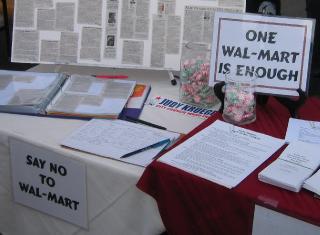
You can't say "One Wal-Mart is Enough" AND stop global climate change, particularly if you offer to give people rides to the Wal-Mart in Moscow. I'm going to repost some information I posted earlier about a Pullman Wal-Mart and global warming.

Two studies have shown that Pullman shoppers spend nearly $100 million annually outside of town, primarily in Moscow, Lewiston, Clarkston, and Spokane.
Based on data derived from the Sightline Institute, the average car with a solo driver produces 1.1 pounds of carbon dioxide emissions per mile traveled.
Therefore, the average round trip between Pullman and an outside shopping destination produces the following carbon dioxide emissions:
That my friends, is how you bust "automobile sprawl," save the planet from global warming, and cause elitist liberal moonbats to short-circuit all at one time!
Technorati Tags: wal-mart walmart
Moscow resident Nils Peterson, who was a member of two subcommittees designated to craft amendments to the ordinance, said the cumulative effects of big-box stores clustered together and a size cap were lost in the amendment process.You know, the only thing funnier than barking moonbattery like this, is when the barking moonbats help to prove your point.
"The dark store provision and cap are important because they are sprawl busters," he said. "It's time for you to step up on the climate-change issue and take action to bust automobile sprawl."
Louise Ashmun said she has been involved with climate-change issues in Moscow.
"I walk almost everywhere and I've gone a whole month without riding in my car," she said. "I have an amazing wonder that such a place exists as Moscow and a large retail store at 130,000 square feet is enormous and completely off character. A walkable city needs to be encouraged and enhanced."
If Nancy Chaney, Aaron Ament, Nils Peterson, et. al., were paid double agents, they couldn't be more useful for Pullman. At a critical moment in our history, as big-box stores and developers start to discover the Palouse, Moscow is being sabotaged from within, undoing in the process three decades of retail dominance. I love it!
Plus, think about it. Nils Peterson and No SuperWalMart's own retail demand study concluded last year that, "As a whole, the Moscow/Pullman area is adequately supplied with retail space, with sales surpluses in Moscow more or less offsetting sales leakages in Pullman." According to Mr. Peterson's own words, we can no longer tolerate that paradigm, as it involves the internal combustion engine. There is no "walkability" BETWEEN cities. In effect, Moscow is Pullman's "automobile sprawl" and we must "bust it" to stop global warming!
And let's not forget PARD's battle cry:
You can't say "One Wal-Mart is Enough" AND stop global climate change, particularly if you offer to give people rides to the Wal-Mart in Moscow. I'm going to repost some information I posted earlier about a Pullman Wal-Mart and global warming.

Two studies have shown that Pullman shoppers spend nearly $100 million annually outside of town, primarily in Moscow, Lewiston, Clarkston, and Spokane.
Based on data derived from the Sightline Institute, the average car with a solo driver produces 1.1 pounds of carbon dioxide emissions per mile traveled.
Therefore, the average round trip between Pullman and an outside shopping destination produces the following carbon dioxide emissions:
Moscow - 20.9 poundsThat one-stop shopping "behemoth" known as a Wal-Mart Supercenter could put an end to unnecessary driving and make Pullman a "Cool City." In fact, as the new Wal-Mart will be well-served by city bus lines and bike and pedestrian paths, shoppers theoretically wouldn't have to drive at all, especially as PARD claims, it will be possible to do all your shopping at Wal-Mart. We could reduce our "carbon footprint" by hundreds of thousands, if not millions, of pounds annually!! In addition, Wal-Mart certainly qualifies as "smart growth," as it is infilling an already highly developed area on Bishop Boulevard!
Lewiston - 70.73 pounds
Clarkston - 73.898 pounds
Spokane - 164.46 pounds
That my friends, is how you bust "automobile sprawl," save the planet from global warming, and cause elitist liberal moonbats to short-circuit all at one time!
Technorati Tags: wal-mart walmart
Tuesday, March 20, 2007
"The 'Church of Global Warming' revisited"
Another great column from Michael O'Neal in today's Moscow-Pullman Daily News, guaranteed to drive the liberals nuts:
Two weeks ago, "Hypocrisy and the Church of Global Warming" appeared on this page. The reaction was predictable: To set me straight, earnest readers sent me scientific stuff. But science wasn't my subject. With tongue in cheek, I took as my subject the sociology and politics of the debate.Amen, Mike.
Allow me to retract my tongue.
Science and religion seek different sorts of truths in different ways. Scientists propose theories. The "willfully ignorant" raise doubts, question those theories, and offer possible alternatives. New data comes in. Theories get tested and modified. Nobel Prize-winning physicist Richard Feynman put it best: Scientists must "be willing to question and doubt their own theories and their own results, and investigate possible flaws in a theory."
But when all doubts, questions and alternatives about global warming are silenced, or when dilettantes launch cowardly personal attacks or make babblescent threats to cancel their subscription to the newspaper because it provides a forum for alternative views, that's religion, not science, and religion in its least attractive guise, so feeble that it can't - or won't - withstand scrutiny. At best it's science by press conference. Not all that long ago, leading scientists fervently believed that criminal propensities could be predicted through cranial measurements. At the same time, they wrongly dismissed plate tectonics as pseudoscience. I say, thank heaven for the doubters and questioners.
Further, I don't like to be told not to drive an SUV by someone with a private jet. Far from being a "distraction," the lives of the rich and famous, many living off the fruits of industrialization, are at the dead center of the debate. The issue is not simply whether global warming is a real problem. I'll grant that it is. The real question is, what do we do now? Every one of us consumes far more than we need. Our cars are too powerful, our houses too palatial, our appetites too piggish. So how are you going to sell the concept of "cutting back" and treading lightly over Mother Earth when the nation's most conspicuous people, including Al Gore himself, or John Edwards and his 28,000-square-foot, $6 million mansion, leave behind Sasquatch-size carbon footprints? So they buy carbon credits. How nice. I can't, so I nibble at the edges of global warming by shivering in my house or driving a tin can death trap, but my actions will accomplish nothing if everyone doesn't play, including the nations that cynically violate the Kyoto agreement they signed with great self-congratulation. And do you think your hybrid Prius and its components were manufactured in plants powered by solar panels?
This raises the issue of alternative energy. Every form of energy, alternative or otherwise, has its downside, but many people don't want to confront global warming in their own backyard. Lord help me, I plead guilty. I might be a proponent of nuclear power - it's clean, and the plants have smaller footprints than conventional power plants - but I don't want one frying my figgins from across the street.
But if a proposal is made for a hydroelectric dam, or a tidal or wave-energy or ocean-current facility, or a wind farm, or the conversion of farmland to cultivation of biomass fuels, trust-fund environmentalists rise as one to oppose it. Back in the 1970s, when the Alaskan oil pipeline was being built, dilettantes who wouldn't know a caribou from a cockatoo waxed hysterical that the pipeline would destroy Alaska's caribou herds. But according to the state's Fish and Game Department, when the oil started to flow in 1977 Alaska's caribou population was about 6,000. Today it's more than 27,000. And the sky did not fall.
Whatever energy source we use, it has to be produced somewhere. If preening "environmentalists" along Cape Cod and elsewhere really believe in global warming, they should be willing to make compromises. Instead, they try to grab the turd by the clean end with cant like "environmentally sensitive area." Yet they heat their homes with oil and coal burned in power plants located in someone else's environmentally sensitive area - in most places, poor neighborhoods - then have the gall to whine if their playground is threatened.
We can fix the problem or be dilettantes. But dilettantes can't make the hard choices, except when they're making them for others.
Subscribe to:
Posts (Atom)
