President Rawlins’ decision to go for the minimum action against a faculty member should be no surprise. He’s following the path of least resistance and trying not to complicate the search for his successor. Welcome to bureaucracy in its most craven form. The administration is banking on the students leaving and the issue dying before it has to be dealt with in a serious manner.
The “World Class” and “Face to Face” tagline elements take on a whole new meaning in light of this incident. The world can reference WSU as the premiere example or cream of the class when it comes to selling out its students and the public while protecting cowardly, self interested administrators and worse than worthless faculty. Face to Face can now be understood to mean “two faced” as they employ two separate standards for behavior, based primarily upon political heat. The students have no real heat. The faculty threatens to use theirs and the politically correct crowd has already fired up the torches. The “investigator” has played the race card as a joker. Since the victims were not part of a protected class, it was used as a weapon for rather than a shield against bigotry and hatred.
If you ever care to see the system change, you will have to pick up the torch and hold it to the administration’s feet. The students are leaving. Only the community can give this issue legs. Arguably, we have a far greater stake in the issue. We are the ones that have to live with this kind of behavior in our community long after the directly involved parties are gone. Yell, scream, get mad as hell and write letters to the editor. Only don’t waste your time on the local papers. Everyone here already knows about this. Drag it back through the Seattle Times, Spokesman Review, Tri-Cities Herald and other publications serving the wider community. Hit ‘em where they live. Hit them where the students come from and where their parents (and donors) read the paper.
Tuesday, December 12, 2006


Slap On the Wrist
The following article can be found today in the Spokesman-Review.
I can't quite understand how it continues to be okay for EX-Streamas to continue working with students. Donors need to start with holding their donations until the university takes action. We cannot continue to allow anyone to be so anti-student in the classroom.
Report criticizes, clears prof
He cursed WSU student at border fence rally
Shawn Vestal
Staff writer
December 12, 2006
An investigation by Washington State University has concluded that a professor was "immature, intellectually unsophisticated and thoughtless" when he cursed at a student demonstrating in favor of a fence along the Mexican border – but that he did not discriminate against or intimidate the student.
The report, dated Dec. 1 and obtained Monday by The Spokesman-Review, also directs some blame for the incident toward WSU's College Republicans, who erected a 24-foot chain-link fence Nov. 2 on the Glenn Terrell Mall.
The group was warned that such a demonstration "would provoke controversy and debate, as well as divisiveness and accusations of racism," the report said
The report by the university's Center for Human Rights was not embraced by either side in the debate over race relations at WSU that has arisen in the wake of the fence demonstration.
Members of the College Republicans have demanded that Professor John Streamas be fired for using a vulgar epithet and have said the incident was an example of bias against conservative views on campus. Dan Ryder, the student who filed the complaint, said the report was a "slap on the wrist" and included a demeaning comment from Streamas that he didn't care about the "hurt feelings of one white person."
"I just feel even more demeaned by this man," Ryder said Monday night. "He knows nothing about me, nothing about where I'm from or how hard I've had to work to keep myself in school."
Attempts to reach top university officials Monday afternoon were unsuccessful. But WSU President V. Lane Rawlins told KREM-2 television last week that Streamas would be reprimanded, but not fired.
"One utterance of a faculty member in the heat of discussion is not the kind of thing for which you terminate someone," he said.
Streamas and other professors in the comparative ethnic studies department say the fence demonstration was a slap in the face for many ethnic students and any university support of that action is an example of institutional racism.
"The only thing I wish I'd done differently is I wish I hadn't gotten angry," Streamas said last week.
The report quoted an unsolicited voice-mail message Streamas left for investigators: "This is a racist university. Many of our students say that WSU stands for White Supremacist University. …
"I don't care about the hurt feelings of one white person. … The feelings of one little hurt white boy who's got all his white-skinned privilege are nothing compared to the hundreds of people he offended with his racist fence."
The incident occurred after the GOP club decided to demonstrate in support of congressional approval of a fence between the U.S. and Mexico as a way of preventing illegal immigration.
Demonstrators and student counterdemonstrators – while engaging in vigorous debate – remained within the legal boundaries of free speech, the report concludes. But Streamas used a racial expletive when talking to Ryder.
The report notes that Ryder objected to the term and Streamas apologized, and then the two continued to debate.
"Neither person appeared intimidated or frightened during the debate," the report said.
Ryder later filed a complaint. The report said it was unwise for Streamas to have cursed at Ryder, but that a single such utterance during a robust debate did not, by itself, constitute harassment, discrimination or intimidation.
Much of the back-and-forth over the incident was captured on video, and the controversy became a cause celebre on conservative radio and television.
I can't quite understand how it continues to be okay for EX-Streamas to continue working with students. Donors need to start with holding their donations until the university takes action. We cannot continue to allow anyone to be so anti-student in the classroom.
Sunday, December 10, 2006
The Word of the Year
According to Merriam-Webster, the people that make those books with all those words, the word of 2006 is Truthiness. Coined by the comedic satirist Stephen Colbert back in 2005, "truthiness" has become a funky way of expressing what's on every one's mind: Just what is the truth anyways? The definition of thruthiness is best described as "truth that comes from the gut, not books."
Merriam-Webster president John Morse had this to say:
We're at a point where what constitutes truth is a question on a lot of people's minds, and truth has become up for grabs. 'Truthiness' is a playful way for us to think about a very important issue.
I'm a fan of Colbert and his Report on Comedy Central, and he's used it quite often. Although it began more as a joke than anything else, it does a very good job of expressing what I consider to be the greatest fallacy of the Information Age. In a time when unlimited information is available at the click of a mouse or the press of a TV remote button, it becomes harder and harder to discern fact from fiction. Anybody, including me, can post whatever they want to on the internet, fact or fiction. I remember in middle school having to use books and print encylopedias to research papers or projects. Now, anything can be found on Google, and it doesn't matter if it's correct or reliable. Today, students researching a project turn to random searches on the internet far more than they do articles in Encyclopaedia Britannica and the like.
Take for example the story about the missing explosives in Iraq that aired just before the 2004 election. This hoax, presented as fact to the American people, had a lot of people believing that incompetence in Iraq whould destroy everything unless new leadership in Washington, D.C. was elected. This is a good example of truthiness. It's not a question of 'is it fact?', but a question of 'do I think it's fact', or 'do I want it to be fact?'
As a student of microbiology, I'm often encouraged by professors to look at the world with a doubtful eye and be mindful of the fact that what we percieve as truth may not be the case. Still, scientific exploration is often curtailed by narrow-mindedness. The scientific community has their way of looking at the world, and anyone that sees it differently is a heretic. I can't imagine how it must be for students of liberal arts. I took a sociology class last year for a diversity credit. Quite often I found myself wondering if the concepts presented were substantiated fact, perceived fact based on biased subjectivity, or opinionated drivel developed by the professor or others as a means to validate the subject matter. I don't mean to say that biology is superior to sociology, but I think it's more difficult for a biology professor to slant scientific information based on opinion, though it does happen.
My point is that the 'truth' should always be taken with a grain of salt. I think God gave us a sense of suspicion for a reason. Without it we may all be tricked into thinking the world is flat. The Information Age's saving grace may be that all kinds of resources are readily avialable to support or detract from our suspicions. Independent research can go far in this day and age. It'll make you feel smarter, too!
Merriam-Webster president John Morse had this to say:
We're at a point where what constitutes truth is a question on a lot of people's minds, and truth has become up for grabs. 'Truthiness' is a playful way for us to think about a very important issue.
I'm a fan of Colbert and his Report on Comedy Central, and he's used it quite often. Although it began more as a joke than anything else, it does a very good job of expressing what I consider to be the greatest fallacy of the Information Age. In a time when unlimited information is available at the click of a mouse or the press of a TV remote button, it becomes harder and harder to discern fact from fiction. Anybody, including me, can post whatever they want to on the internet, fact or fiction. I remember in middle school having to use books and print encylopedias to research papers or projects. Now, anything can be found on Google, and it doesn't matter if it's correct or reliable. Today, students researching a project turn to random searches on the internet far more than they do articles in Encyclopaedia Britannica and the like.
Take for example the story about the missing explosives in Iraq that aired just before the 2004 election. This hoax, presented as fact to the American people, had a lot of people believing that incompetence in Iraq whould destroy everything unless new leadership in Washington, D.C. was elected. This is a good example of truthiness. It's not a question of 'is it fact?', but a question of 'do I think it's fact', or 'do I want it to be fact?'
As a student of microbiology, I'm often encouraged by professors to look at the world with a doubtful eye and be mindful of the fact that what we percieve as truth may not be the case. Still, scientific exploration is often curtailed by narrow-mindedness. The scientific community has their way of looking at the world, and anyone that sees it differently is a heretic. I can't imagine how it must be for students of liberal arts. I took a sociology class last year for a diversity credit. Quite often I found myself wondering if the concepts presented were substantiated fact, perceived fact based on biased subjectivity, or opinionated drivel developed by the professor or others as a means to validate the subject matter. I don't mean to say that biology is superior to sociology, but I think it's more difficult for a biology professor to slant scientific information based on opinion, though it does happen.
My point is that the 'truth' should always be taken with a grain of salt. I think God gave us a sense of suspicion for a reason. Without it we may all be tricked into thinking the world is flat. The Information Age's saving grace may be that all kinds of resources are readily avialable to support or detract from our suspicions. Independent research can go far in this day and age. It'll make you feel smarter, too!
Saturday, December 09, 2006
"In Praise of Chain Stores"
There is a really good article in the December 2006 edition of The Atlantic Monthly written by Virginia Postrel. It begs the question: How much of PARD's vision for Pullman is the perpetuation of a non-(and never-) existent myth?
Besides, the idea that America was once filled with wildly varied business establishments is largely a myth. Big cities could, and still can, support more retail niches than small towns. And in a less competitive national market, there was certainly more variation in business efficiency—in prices, service, and merchandise quality. But the range of retailing ideas in any given town was rarely that great. One deli or diner or lunch counter or cafeteria was pretty much like every other one. A hardware store was a hardware store, a pharmacy a pharmacy. Before it became a ubiquitous part of urban life, Starbucks was, in most American cities, a radically new idea.
Chains do more than bargain down prices from suppliers or divide fixed costs across a lot of units. They rapidly spread economic discovery—the scarce and costly knowledge of what retail concepts and operational innovations actually work. That knowledge can be gained only through the expensive and time-consuming process of trial and error. Expecting each town to independently invent every new business is a prescription for real monotony, at least for the locals. Chains make a large range of choices available in more places. They increase local variety, even as they reduce the differences from place to place. People who mostly stay put get to have experiences once available only to frequent travelers, and this loss of exclusivity is one reason why frequent travelers are the ones who complain. When Borders was a unique Ann Arbor institution, people in places like Chandler—or, for that matter, Philadelphia and Los Angeles—didn’t have much in the way of bookstores. Back in 1986, when California Pizza Kitchen was an innovative local restaurant about to open its second location, food writers at the L.A. Daily News declared it “the kind of place every neighborhood should have.” So what’s wrong if the country has 158 neighborhood CPKs instead of one or two?
The process of multiplication is particularly important for fast-growing towns like Chandler, where rollouts of established stores allow retail variety to expand as fast as the growing population can support new businesses. I heard the same refrain in Chandler that I’ve heard in similar boomburgs elsewhere, and for similar reasons. “It’s got all the advantages of a small town, in terms of being friendly, but it’s got all the things of a big town,” says Scott Stephens, who moved from Manhattan Beach, California, in 1998 to work for Motorola. Chains let people in a
city of 250,000 enjoy retail amenities once available only in a huge metropolitan center. At the same time, familiar establishments make it easier for people to make a home in a new place. When Nissan recently moved its headquarters from Southern California to Tennessee, an unusually high percentage of its Los Angeles–area employees accepted the transfer. “The fact that Starbucks are everywhere helps make moving a lot easier these days,” a rueful Greg Whitney, vice president of business development for the Los Angeles County Economic Development Corporation, told the Los Angeles Times reporter John O’Dell. Orth Hedrick, a Nissan product manager, decided he could stay with the job he loved when he turned off the interstate near Nashville and realized, “You could really be Anywhere, U.S.A. There’s a great big regional shopping mall, and most of the stores and restaurants are the same ones we see in California. Yet a few miles away you’re in downtown, and there’s lots of local color, too.”
Contrary to the rhetoric of bored cosmopolites, most cities don’t exist primarily to please tourists. The children toddling through the Chandler mall hugging their soft Build-A-Bear animals are no less delighted because kids can also build a bear in Memphis or St. Louis. For them, this isn’t tourism; it’s life—the experiences that create the memories from which the meaning of a place arises over time. Among Chandler’s most charming sights are the business-casual dads joining their wives and kids for lunch in the mall food court. The food isn’t the point, let alone whether it’s from Subway or Dairy Queen. The restaurants merely provide the props and setting for the family time. When those kids grow up, they’ll remember the food court as happily as an older generation recalls the diners and motels of Route 66—not because of the businesses’ innate appeal but because of the memories they evoke.
The contempt for chains represents a brand-obsessed view of place, as if store names were all that mattered to a city’s character. For many critics, the name on the store really is all that matters. The planning consultant Robert Gibbs works with cities that want to revive their downtowns, and he also helps developers find space for retailers. To his frustration, he finds that many cities actually turn away national chains, preferring a moribund downtown that seems authentically local. But, he says, the same local activists who oppose chains “want specialty retail that sells exactly what the chains sell—the same price, the same fit, the same qualities, the same sizes, the same brands, even.” You can show people pictures of a Pottery Barn with nothing but the name changed, he says, and they’ll love the store. So downtown stores stay empty, or sell low-value tourist items like candles and kites, while the chains open on the edge of town. In the name of urbanism, officials and activists in cities like Ann Arbor and Fort Collins, Colorado, are driving business to the suburbs. “If people like shopping at the Banana Republic or the Gap, if that’s your market—or Payless Shoes—why not?” says an exasperated Gibbs. “Why not sell the goods and services people want?” HT: SK Peterson
They aren’t destroying local flavor—they’re providing variety and comfortFamiliar retailers may take some of the discovery out of travel—to the consternation of journalists looking for obvious local color—but by holding some of the commercial background constant, chains make it easier to discern the real differences that define a place: the way, for instance, that people in Chandler come out to enjoy the summer twilight, when the sky glows purple and the dry air cools.
Every well-traveled cosmopolite knows that America is mind-numbingly monotonous—the most boring country to tour, because everywhere looks like everywhere else,” as the columnist Thomas Friedman once told Charlie Rose. Boston has the same stores as Denver, which has the same stores as Charlotte or Seattle or Chicago. We live in a “Stepford world,” says Rachel Dresbeck, the author of Insiders’ Guide to Portland, Oregon. Even Boston’s historic Faneuil Hall, she complains, is “dominated by the Gap, Anthropologie, Starbucks, and all the other usual suspects. Why go anywhere? Every place looks the same.” This complaint is more than the old worry, dating back to the 1920s, that the big guys are putting Mom and Pop out of business. Today’s critics focus less on what isn’t there—Mom and Pop—than on what is. Faneuil Hall actually has plenty of locally owned businesses, from the Geoclassics store selling minerals and jewelry, to Pizzeria Regina (“since 1926”). But you do find the same chains everywhere.
The suburbs are the worst. Take Chandler, Arizona, just south of Phoenix. At Chandler Fashion Center, the area’s big shopping mall, you’ll find P. F. Chang’s, California Pizza Kitchen, Chipotle Mexican Grill, and the Cheesecake Factory. Drive along Chandler’s straight, flat boulevards, and you’ll see Bed Bath & Beyond and Linens-n-Things; Barnes & Noble and Borders; PetSmart and Petco; Circuit City and Best Buy; Lowe’s and Home Depot; CVS and Walgreens. Chandler has the Apple Store and Pottery Barn, the Gap and Ann Taylor, Banana Republic and DSW, and, of course, Target and Wal-Mart, Starbucks and McDonald’s. For people allergic to brands, Chandler must be hell—even without the 110-degree days.
One of the fastest-growing cities in the country, Chandler is definitely the kind of place urbanists have in mind as they intone, “When every place looks the same, there is no such thing as place anymore.” Like so many towns in America, it has lost much of its historic character as a farming community. The annual Ostrich Festival still honors one traditional product, but these days Chandler raises more subdivisions and strip malls than ostrich plumes or cotton, another former staple. Yet it still refutes the common assertion that national chains are a blight on the landscape, that they’ve turned American towns into an indistinguishable “geography of nowhere.”
The first thing you notice in Chandler is that, as a broad empirical claim, the cliché that “everywhere looks like everywhere else” is obvious nonsense. Chandler’s land and air and foliage are peculiar to the desert Southwest. The people dress differently. Even the cookie-cutter housing developments, with their xeriscaping and
washed-out desert palette, remind you where you are. Forget New England clapboard, Carolina columns, or yellow Texas brick. In the intense sun of Chandler, the red-tile roofs common in California turn a pale, pale pink.
Stores don’t give places their character. Terrain and weather and culture do.
Besides, the idea that America was once filled with wildly varied business establishments is largely a myth. Big cities could, and still can, support more retail niches than small towns. And in a less competitive national market, there was certainly more variation in business efficiency—in prices, service, and merchandise quality. But the range of retailing ideas in any given town was rarely that great. One deli or diner or lunch counter or cafeteria was pretty much like every other one. A hardware store was a hardware store, a pharmacy a pharmacy. Before it became a ubiquitous part of urban life, Starbucks was, in most American cities, a radically new idea.
Chains do more than bargain down prices from suppliers or divide fixed costs across a lot of units. They rapidly spread economic discovery—the scarce and costly knowledge of what retail concepts and operational innovations actually work. That knowledge can be gained only through the expensive and time-consuming process of trial and error. Expecting each town to independently invent every new business is a prescription for real monotony, at least for the locals. Chains make a large range of choices available in more places. They increase local variety, even as they reduce the differences from place to place. People who mostly stay put get to have experiences once available only to frequent travelers, and this loss of exclusivity is one reason why frequent travelers are the ones who complain. When Borders was a unique Ann Arbor institution, people in places like Chandler—or, for that matter, Philadelphia and Los Angeles—didn’t have much in the way of bookstores. Back in 1986, when California Pizza Kitchen was an innovative local restaurant about to open its second location, food writers at the L.A. Daily News declared it “the kind of place every neighborhood should have.” So what’s wrong if the country has 158 neighborhood CPKs instead of one or two?
The process of multiplication is particularly important for fast-growing towns like Chandler, where rollouts of established stores allow retail variety to expand as fast as the growing population can support new businesses. I heard the same refrain in Chandler that I’ve heard in similar boomburgs elsewhere, and for similar reasons. “It’s got all the advantages of a small town, in terms of being friendly, but it’s got all the things of a big town,” says Scott Stephens, who moved from Manhattan Beach, California, in 1998 to work for Motorola. Chains let people in a
city of 250,000 enjoy retail amenities once available only in a huge metropolitan center. At the same time, familiar establishments make it easier for people to make a home in a new place. When Nissan recently moved its headquarters from Southern California to Tennessee, an unusually high percentage of its Los Angeles–area employees accepted the transfer. “The fact that Starbucks are everywhere helps make moving a lot easier these days,” a rueful Greg Whitney, vice president of business development for the Los Angeles County Economic Development Corporation, told the Los Angeles Times reporter John O’Dell. Orth Hedrick, a Nissan product manager, decided he could stay with the job he loved when he turned off the interstate near Nashville and realized, “You could really be Anywhere, U.S.A. There’s a great big regional shopping mall, and most of the stores and restaurants are the same ones we see in California. Yet a few miles away you’re in downtown, and there’s lots of local color, too.”
Contrary to the rhetoric of bored cosmopolites, most cities don’t exist primarily to please tourists. The children toddling through the Chandler mall hugging their soft Build-A-Bear animals are no less delighted because kids can also build a bear in Memphis or St. Louis. For them, this isn’t tourism; it’s life—the experiences that create the memories from which the meaning of a place arises over time. Among Chandler’s most charming sights are the business-casual dads joining their wives and kids for lunch in the mall food court. The food isn’t the point, let alone whether it’s from Subway or Dairy Queen. The restaurants merely provide the props and setting for the family time. When those kids grow up, they’ll remember the food court as happily as an older generation recalls the diners and motels of Route 66—not because of the businesses’ innate appeal but because of the memories they evoke.
The contempt for chains represents a brand-obsessed view of place, as if store names were all that mattered to a city’s character. For many critics, the name on the store really is all that matters. The planning consultant Robert Gibbs works with cities that want to revive their downtowns, and he also helps developers find space for retailers. To his frustration, he finds that many cities actually turn away national chains, preferring a moribund downtown that seems authentically local. But, he says, the same local activists who oppose chains “want specialty retail that sells exactly what the chains sell—the same price, the same fit, the same qualities, the same sizes, the same brands, even.” You can show people pictures of a Pottery Barn with nothing but the name changed, he says, and they’ll love the store. So downtown stores stay empty, or sell low-value tourist items like candles and kites, while the chains open on the edge of town. In the name of urbanism, officials and activists in cities like Ann Arbor and Fort Collins, Colorado, are driving business to the suburbs. “If people like shopping at the Banana Republic or the Gap, if that’s your market—or Payless Shoes—why not?” says an exasperated Gibbs. “Why not sell the goods and services people want?” HT: SK Peterson
First Annual Palousitics Blog Fest/Christmas Party
Last night's First Annual Palousitics Blog Fest/Christmas Party was a huge success! 18 Palousitics contributors, commenters, and lurkers from all walks of life gathered at Pullman Grill and Bar to put the faces behind the names and socialize.
Scotty had to leave very early on official duties. But here is your The PES lineup from last semester, the Dynamic Duo, Batman and the Boy Wonder!:
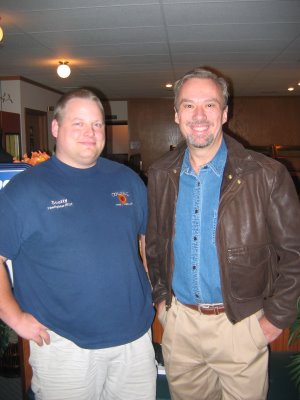
At one point, The Red Knight wondered if we should all be in one room together. Paul Zimmerman agreed, saying a "Godfather Part III" style helicopter hit on the restaurant by the liberals could whack all of Pullman's conservative leadership in one fell swoop!
Here I am with our two national media celebrities and heroes of free speech, Danny Schanze, WSU College Republicans Political Action Chair, and Dan Ryder, Vice Chairman of the Washington State College Republican Federation:
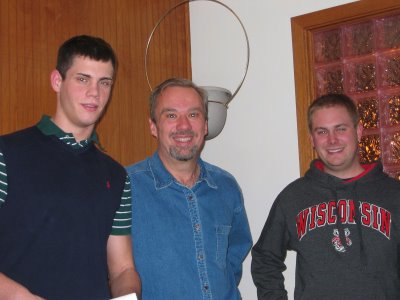
I'm very proud of all the WSU CRs and was glad that many of them could make it last night.
And here is what local left-wingers would consider to be the Axis of Evil in the Pullman-Moscow area, blogger Dale Courtney of Right Mind and myself:
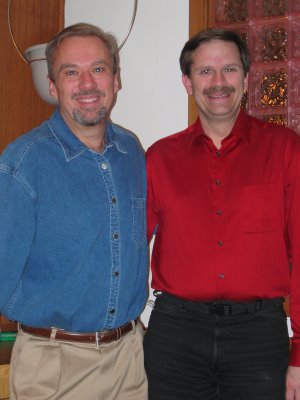
Dale is one of the "blogfathers" of Palousitics, being a big influence and inspiration when I first got started. Of course, I should have invited TV Reed to come also. There would be no Palousitics (and no party last night) without PARD's jihad against Wal-Mart.
I really consider it an honor to be able to call all these people my friends.
As Josh pointed out, Palousitics has become a portal to issues that affect the community and brought like-minded people together who have shown their potential to work toward a common goal. From Wal-Mart to local elections to taking the WSU CRs fight for free speech and academic diversity and tolerance to the national stage, TOGETHER WE HAVE MADE A BIG DIFFERENCE!! And we're not done yet. As we dicussed last night, the battle over Wal-Mart continues, the CRs battle must be kept going (and funded, please click on the WSU logo at right and consider making a donation), and bringing forward the need to widen US 195, which has claimed so many lives in the last few weeks.
Joe Carter, at the Evangelical Outpost blog, came up with the excellent "5/150 Principle:"
Scotty had to leave very early on official duties. But here is your The PES lineup from last semester, the Dynamic Duo, Batman and the Boy Wonder!:
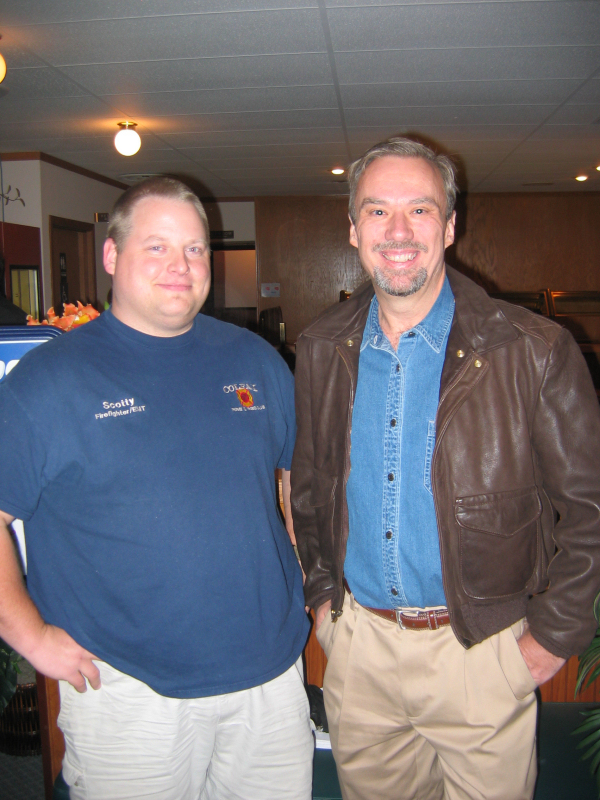
At one point, The Red Knight wondered if we should all be in one room together. Paul Zimmerman agreed, saying a "Godfather Part III" style helicopter hit on the restaurant by the liberals could whack all of Pullman's conservative leadership in one fell swoop!
Here I am with our two national media celebrities and heroes of free speech, Danny Schanze, WSU College Republicans Political Action Chair, and Dan Ryder, Vice Chairman of the Washington State College Republican Federation:
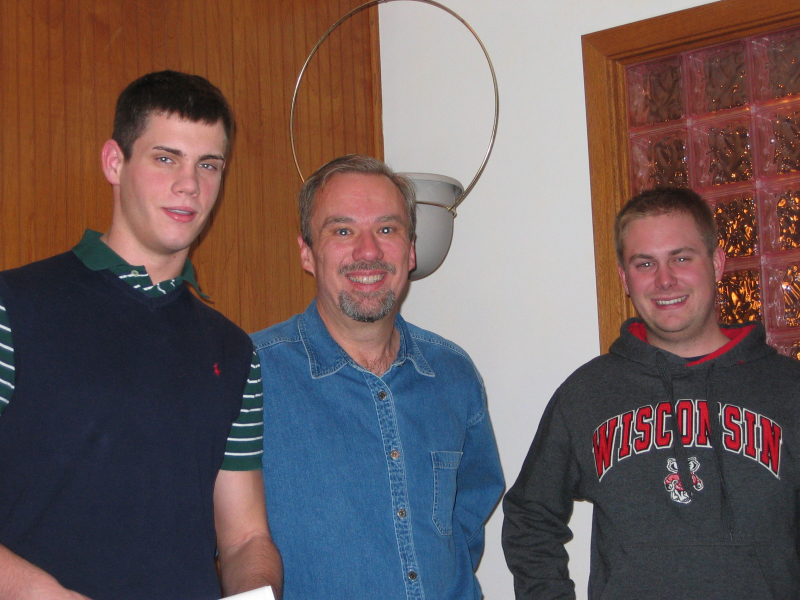
I'm very proud of all the WSU CRs and was glad that many of them could make it last night.
And here is what local left-wingers would consider to be the Axis of Evil in the Pullman-Moscow area, blogger Dale Courtney of Right Mind and myself:
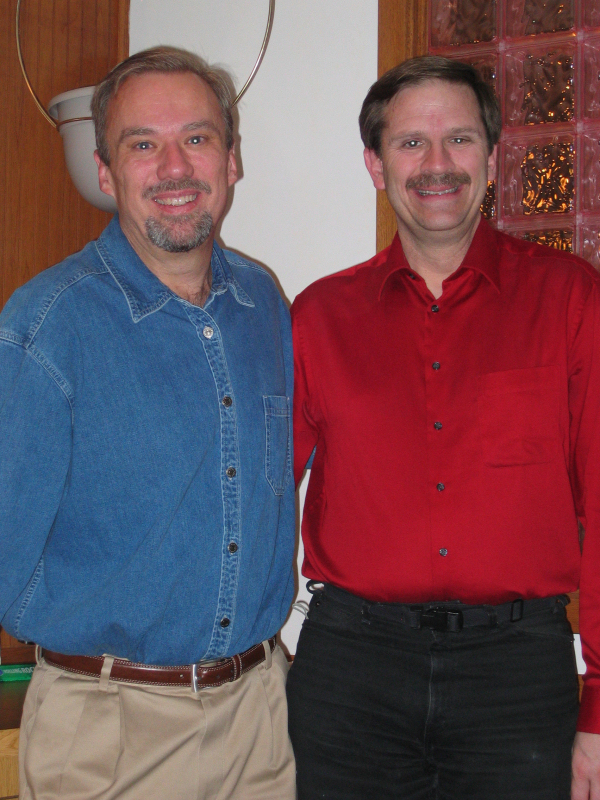
Dale is one of the "blogfathers" of Palousitics, being a big influence and inspiration when I first got started. Of course, I should have invited TV Reed to come also. There would be no Palousitics (and no party last night) without PARD's jihad against Wal-Mart.
I really consider it an honor to be able to call all these people my friends.
As Josh pointed out, Palousitics has become a portal to issues that affect the community and brought like-minded people together who have shown their potential to work toward a common goal. From Wal-Mart to local elections to taking the WSU CRs fight for free speech and academic diversity and tolerance to the national stage, TOGETHER WE HAVE MADE A BIG DIFFERENCE!! And we're not done yet. As we dicussed last night, the battle over Wal-Mart continues, the CRs battle must be kept going (and funded, please click on the WSU logo at right and consider making a donation), and bringing forward the need to widen US 195, which has claimed so many lives in the last few weeks.
Joe Carter, at the Evangelical Outpost blog, came up with the excellent "5/150 Principle:"
But having a larger audience doesn't necessarily translate into having more influence. As Malcolm Gladwell argues in his book The Tipping Point, the maximum number of individuals with whom we can have a genuinely social relationship is about 150. In blogging terms, this means that when your readership grows, you're ability to have a true one-on-one relationship with them decreases significantly. This is not to say that you should attempt to limit your readership to 150 readers, turning people away when that number is reached. What it means is that if you want to maximize your personal influence you would focus on establishing strong bonds and deep interaction with at most 150 readers.The latest stats of 273 unique visitors a day with an average visit length of 4 minutes and 9 seconds show that Palousitics is reaching the goals of Carter's "5/150 Principle" and we are now focusing on establishing the strong bonds and deep interaction to continue working on positive change for Pullman, WSU, and the Palouse.
Now consider what would happen if each of these 150 readers read and thought about what you wrote on your blog for five minutes every day. Five minutes may seem insignificant but it has an exponential effect: with only 5 minutes every day, six days a week, every month, you will have the reader's attention for more than one entire day--26 hours--every year. With only 150 consistent readers you will have gained the equivalent "mindspace" of one person for one entire day for almost five straight months. This is what I call the "5/150 Principle": capturing the mindspace of 150 people for 5 minutes can create an astounding opportunity for influence.
Godspeed, Josh
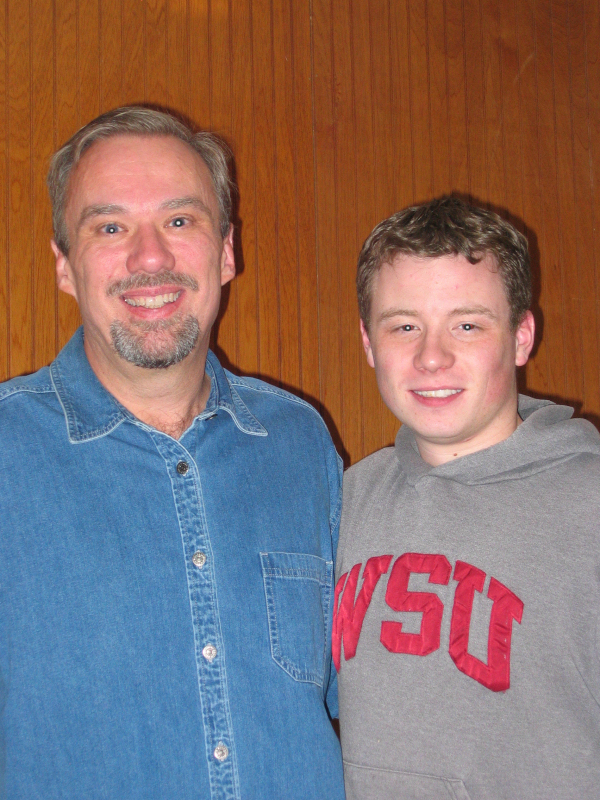
Longtime Palousitics contributor, Businesses & Residents for Economic Opportunity Vice-Chair, and former Pullman City Council candidate Josh Coke (on the right in the picture with me above) was at last night's Palousitics Christmas Party. He's graduating from WSU today and moving on to new opportunities on the west side of the state.
Josh sent me this nice e-mail afterwards:
Tom,I think I speak for everyone when I say that it has been a tremendous privilege working with Josh and we wish him all the best. I still believe one day that we all be able to say "we knew him when" after Josh is elected Congressman or Senator!
Just wanted to say thanks for getting everyone together for dinner and drinks tonight, it was a kick to finally put some names to faces and share a few laughs. It's been a real pleasure getting to know you and so many others in Pullman during the short time I've been here and I'm extremely grateful for the guidance you've offered along the way. You're doing a great job providing a portal to issues that affect the community, and based on some of the floggings I've seen you stand up to in the paper, you don't always hear that enough. You've brought a lot of like-minded people together who have shown their potential to work toward a common goal and we're better off for it. Thanks for everything, and keep up the great work.
Josh
"Let’s move on and welcome Wal-Mart"
This is another awesome letter to the editor in today's Daily News. I hope PARD realizes that these are average residents, not "Wal-Mart fanatics" like Don Pelton and myself. PARD has officially worn out its welcome in Pullman.
Drive over to Wal-Mart in Moscow. Count all of the Washington license plates. The count might shock you. Let’s keep that money in Pullman. Let Pullman reap the benefits. Our schools, the roads, the town businesses and the townspeople would thrive by Wal-Mart.
I don’t own a business in Pullman. I have great connections to those who do and support Wal-Mart. Here’s a thought for you PARD — why not conduct a vote of Pullman residents? Take a tally of all those in favor and all those opposing. Oh, that’s right, that would only reveal the truth.
You are not after the truth — you’re just a pimple that won’t go away. Move onto something else PARD and welcome Wal-Mart.
Ami Libey, Pullman
Technorati Tags: wal-mart walmart
I cannot keep silent any longer. The Pullman Alliance for Responsible Development has continuously picked at Wal-Mart as if it was a pimple on its face.Wal-Mart allows average income families to purchase name brand items at a lower cost. Those of us on a budget need to shop at Wal-Mart.Those who are part of PARD obviously are not on budgets or they would not be crying so loud.
I have lived in Pullman for more than 30 years. I am an average working parent with three children. I was educated in the Pullman schools. I have always worked in Pullman. I believe in Pullman’s growth and hometown charm. I cannot believe that PARD is able to spend Pullman taxpayers’ money on such nonsense. Grow up. I work hard for my money and any tax money that I give to Pullman I personally do not want spent by PARD.
The schools, the streets and the parks need the money not PARD. Many of the true Pullman townspeople welcome Wal-Mart with open arms.
Drive over to Wal-Mart in Moscow. Count all of the Washington license plates. The count might shock you. Let’s keep that money in Pullman. Let Pullman reap the benefits. Our schools, the roads, the town businesses and the townspeople would thrive by Wal-Mart.
I don’t own a business in Pullman. I have great connections to those who do and support Wal-Mart. Here’s a thought for you PARD — why not conduct a vote of Pullman residents? Take a tally of all those in favor and all those opposing. Oh, that’s right, that would only reveal the truth.
You are not after the truth — you’re just a pimple that won’t go away. Move onto something else PARD and welcome Wal-Mart.
Ami Libey, Pullman
Technorati Tags: wal-mart walmart
"Numbers suit PARD’s purpose"
The first of two anti-PARD letters in today's Moscow-Pullman Daily News:
Technorati Tags: wal-mart walmart
If Wal-Mart opponents would like to cite us some meaningful statistics about the number of Wal-Mart employees who receive taxpayer subsidized health-care benefits, I would suggest they compare the total benefit dollars paid those workers while in the employ of Wal-Mart to the benefits paid those same workers in the year prior to their employment, inclusive of unemployment benefits. But then, I suspect those numbers wouldn’t really suit the purpose.
Curt Parsons, Moscow
Technorati Tags: wal-mart walmart
Friday, December 08, 2006
We wish you a Merry Christmas!
With Music on Vimeo
Just add music and stir. The WSU College Republicans wish you a very Merry Christmas!
The PARD Desperation is Palpable
First, we had this letter in today's Moscow-Pullman Daily News that concludes:
Speaking of regulating competition, I won't repeat all of TV Screed's rambling column from today, other than to point out some laughable assertions he made, including:
Secondly, as usual, Reed and PARD completely ignore the massive retail sales leakge from Pullman to Moscow that was even pointed out by a study funded by PARD's ally group in Moscow, No Super WalMart, that concluded the following:
While it is impossible to state with certainty without conducting consumer surveys where Pullman's residents currently shop for various things, it is highly likely, given Moscow's high per capita sales performance relative to Pullman's and the region's relatively isolated location, that Pullman residents often shop in Moscow for groceries and other consumer staples.
The 223,000 square foot Wal-Mart Supercenter that has been proposed to be built in Pullman will attract approximately $100 million in sales - roughly the equivalent of all current sales in major retail categories in Pullman - according to Wal-Mart's current national sales averages. This will have an enormous impact on retail activity in the region - in Pullman, in particular, but also in Moscow, as some sales currently being captured by Moscow businesses will almost certainly gravitate to the new Wal-Mart Supercenter. Grocery sales are particularly vulnerable, as the proposed Supercenter will likely capture approximately $35 million in area grocery sales. If anyone's going to lose out from a Pullman Wal-Mart, it's going to be Moscow businesses like Wal-Mart and Winco. Again, who cares?
Reed, as usual, focuses on Troy Woo's regrettable conclusion that Pullman would see estimated economic gain at $41,587 from Wal-Mart. Anyone with even the slightest understanding of economics could tell you that those numbers are very low, and I have no idea how Woo came up with them (he's not an economist specializing in economic impact)). As seen above, CLUE estimates sales at $100 million a year, the standard for Wal-Mart Supercenters. That's $850,000 as year in sales taxes alone. That's no wild exagerration, that's state law. The "vast majority of money gained in sales tax will be offset by losses to other community businesses" What? If a $100 million a year is being spent at 20 Pullman businesses (which would not be the case anyway) or at Wal-Mart, the city still collects the same amount of sales tax. Talk about "voodoo economics," I hope everyone else can see through Reed's "all I needed to know about debating I learned in Kindergarten" reasoning.
Let's extend Reed's justification of "it's only a dollar" to Don Orlich's claim earlier this week that Pullman citizens are footing Wal-Mart's medical bills of $9 million. Washington's population by latest estimate is 6,375,600. That's $1.41 for every citizen of Washington, and a total cost to Pullman of a whopping $38,112.30.
Now, apply PARD's cost to taxpayers thus far, $36,300.25 to Pullman's population of 27,030 and you get $1.34 per resident and that's before this next round of appeals. Wal-Mart is definitely the better bargain.
Technorati Tags: wal-mart walmart
I sincerely hope the Pullman Alliance for Responsible Development does not “move on.” They speak for many in your community, and beyond.Huh? Someone from way down in Medford, OR claims PARD speaks for many in Pullman. Oh wait, Morrell said "I subscribe to your paper electronically...I plan to move my family to the Moscow-Pullman area." Sure buddy. Mr. Morrell is nothing more than a mercenary recruited by PARD since they can't find enough people in Pullman to write letters. Witness Mr. Morrell's letter to the editor of the (Southern Oregon) Mail Tribune in February of this year, in which he stated:
Scott Morrell, Medford, Ore.
"Albertsons sells to investor group." This Jan. 24 story on the MT business page failed to mention what the Oregonian reported: "Albertsons has been looking to sell the company in part because of competitive pressure by Wal-Mart, which has vaulted to the top of the U.S. grocery business with $80 billion in annual sales."Morrell, no doubt a member of the anti-Wal-Mart Medford Citizens for Responsible Development (catchy name, huh?) is apparently yet another socialist, intent on having the government regulate competition among businesses.
According to BusinessWeek Online, Albertsons found it difficult to compete because its labor is unionized, and labor makes up 70 percent of a traditional grocer’s overhead.
Speaking of regulating competition, I won't repeat all of TV Screed's rambling column from today, other than to point out some laughable assertions he made, including:
Every dollar made by Wal-Mart’s grocery will be a dollar lost by Safeway or Dissmore’s. Every dollar made at Wal-Mart’s pharmacy will be a loss to Sid’s or Rite Aid. Every dollar made on pet supplies, electronics, appliances, clothes, household items, lube jobs and tire sales, sporting goods, beauty care, and on and on will come out of the hide of someone else in town who already provides those things. This is why we believe the court will conclude that approval of Wal-Mart violates city codes requiring that fiscal impact be determined.First, why would Pullman, or anyone else for that matter, care whether Wal-Mart takes a dollar away from another chain store like Safeway, Dissmores, or Rite-Aid? This is such a specious argument, just like Morrell's defense of Albertson's above. Pullman is so underretailed, Reed can't even find a good Mom-and-Pop store to throw into the argument. Let the consumers decide and may the best store win.
Secondly, as usual, Reed and PARD completely ignore the massive retail sales leakge from Pullman to Moscow that was even pointed out by a study funded by PARD's ally group in Moscow, No Super WalMart, that concluded the following:
, including a leakage of $4.0 million in groceries, $7.6 million in furniture/home furnishings, $9.6 million in apparel, and $1.3 million in pharmaceuticals/medical supplies (the only major retail category in which Pullman is experiencing a sales surplus is dining out).Pullman, however, is experiencing sales leakages in almost all major retail categories
Reed, as usual, focuses on Troy Woo's regrettable conclusion that Pullman would see estimated economic gain at $41,587 from Wal-Mart. Anyone with even the slightest understanding of economics could tell you that those numbers are very low, and I have no idea how Woo came up with them (he's not an economist specializing in economic impact)). As seen above, CLUE estimates sales at $100 million a year, the standard for Wal-Mart Supercenters. That's $850,000 as year in sales taxes alone. That's no wild exagerration, that's state law. The "vast majority of money gained in sales tax will be offset by losses to other community businesses" What? If a $100 million a year is being spent at 20 Pullman businesses (which would not be the case anyway) or at Wal-Mart, the city still collects the same amount of sales tax. Talk about "voodoo economics," I hope everyone else can see through Reed's "all I needed to know about debating I learned in Kindergarten" reasoning.
As for the alleged costs of the Wal-Mart defense to the city, why are they paying anything at all? Wal-Mart has a multi-million dollar budget to fight lawsuits (they are facing hundreds in communities all over the country) and a lawyer who does nothing but travel around the Northwest defending the giant corporation against local residents. He just lost a case in Oregon, and Bellingham also recently succeeded in keeping a super center out of town. City attorney Laura McAloon estimates city court costs as $27,000. That’s less than $1 per local resident – a small price to pay to ensure safety and economic stability — but even this small amount should have been covered by Wal-Mart.Contrast this with Reed's earlier statement:
Reed said the city has McAloon on retainer, and appealing at the different court levels does not put a financial strain on the city.Oops.
Let's extend Reed's justification of "it's only a dollar" to Don Orlich's claim earlier this week that Pullman citizens are footing Wal-Mart's medical bills of $9 million. Washington's population by latest estimate is 6,375,600. That's $1.41 for every citizen of Washington, and a total cost to Pullman of a whopping $38,112.30.
Now, apply PARD's cost to taxpayers thus far, $36,300.25 to Pullman's population of 27,030 and you get $1.34 per resident and that's before this next round of appeals. Wal-Mart is definitely the better bargain.
Technorati Tags: wal-mart walmart
Subscribe to:
Posts (Atom)
